Table of Contents
Landscape design is evolving
Irrigation design for professional gardens is changing because the way green spaces are designed has changed. Today’s residential, hospitality and outdoor living projects often combine smaller lawn areas, mixed flower beds, borders, terraces, pots, permeable paving, relaxation areas, swimming pools and visible ornamental greenery.
For installers, designers and retailers, this means making a clear technical choice: the irrigation system can no longer be treated as a single, uniform area. It must be designed as a set of zones, each with different water requirements and therefore requiring precise planning and the right product selection.

garden
Sprinkler irrigation: use it where surface coverage is really needed
Sprinkler irrigation remains the right solution for continuous lawns, regular surfaces and areas where overhead water distribution is still the most functional choice. In these cases, the key technical factor is coverage quality. Landscape irrigation standards indicate that, in square or rectangular layouts, the distance between sprinklers should not exceed 50% of the coverage diameter. The same standards also state that spray lines should be designed so that pressure variation within the zone does not exceed 10%.
These figures explain why sprinkler irrigation only works well when throw distance, pressure, spacing and flow rate are designed consistently. It is less suitable for narrow flower beds, borders, terraces, areas close to paving or fragmented spaces, where overspray, wind drift and off-target wetting become harder to control.

Micro-irrigation: choosing the right device according to the layout of the green area
Micro-irrigation includes a range of low-flow solutions: dripline, drippers, micro-sprays, micro-sprinklers and bubblers. The difference between them is not just a matter of name, but of design approach.
Dripline: why it is now central to landscape irrigation
In professional landscaping, dripline is becoming increasingly important because it meets three very practical needs: irrigating continuous planted areas, reducing the visual presence of the system and simplifying the management of areas where sprinklers would be less precise. It is therefore suitable for hedges, borders, mulched flower beds, linear planting areas, ornamental trees, roof gardens and outdoor spaces close to paved surfaces.
The technical choice must take into account flow rate, spacing, operating pressure, line length, filtration and flushing. Industry standards require pressure-regulating devices on all drip systems and also indicate suitable filtration, with reference to 100 mesh for drippers with flow rates above 3.8 l/h and 130 microns (120 mesh) for flow rates below 2.8 l/h.
With Multibar® F, Irritec offers a dripline with a flat pressure-compensating dripper and silicone membrane. The a.s. versions are useful when the aim is to reduce the risk of impurities being sucked into the system, while the d.s. — Drop Stop — versions prevent the line from emptying at the end of the cycle. This is an advantage in short irrigation cycles, complex installations, sloping lines and systems where fast, uniform restart is important.
Subsurface lawn irrigation: a technical opportunity, not a trend
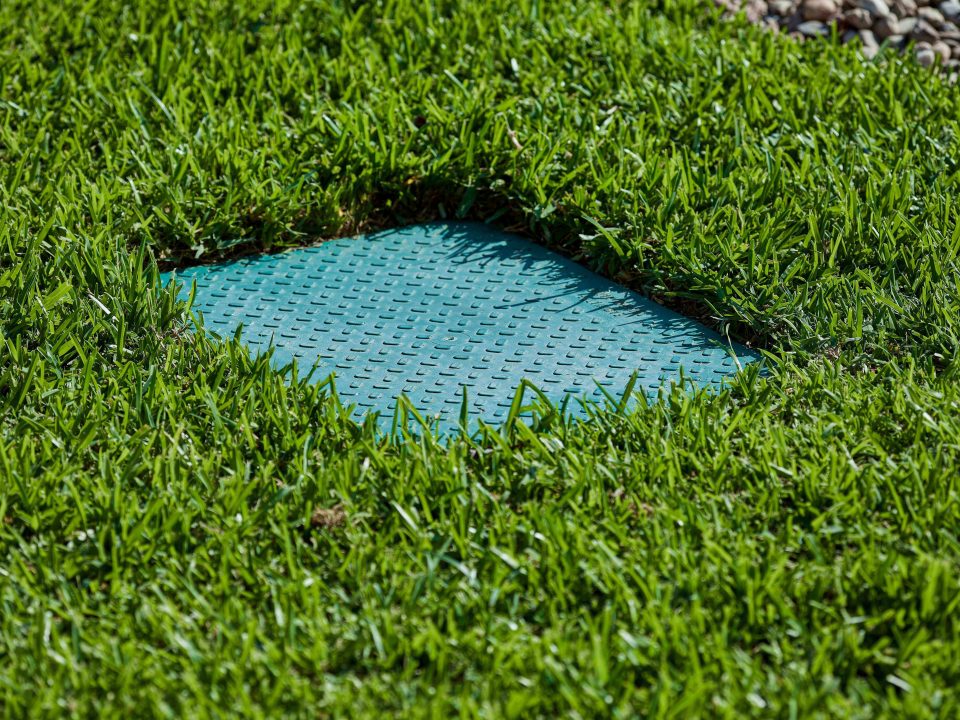
Subsurface drip irrigation for turf should be considered a specific technical solution, not an automatic replacement for sprinkler irrigation. It is particularly interesting when the project requires invisible, vandal-resistant systems working at low pressure, surfaces free from sprinklers and always usable, less interference with furnishings and paving, and greater control of the root zone. It is also especially useful in very windy areas.
Technical guidelines for turf subsurface irrigation show that water moves by capillarity, creating a moist layer below the root zone. Before choosing the hardware, it is necessary to assess the maximum water requirement of the turf, water availability and quality, soil type and aeration practices. For turf installations, a depth of around 10–15 cm below ground level is generally preferred, with spacing of 30–33 cm and 30–33 cm between lines. If distances are increased too much, the risk of dry strips becomes greater.
This is an important point for designers and installers: subsurface irrigation is a high-value solution that requires driplines suitable for underground installation, filtration systems, valves, accessible line ends and scheduled maintenance.
Armonia®: when the system must remain technical but visually integrated
In contemporary landscape projects, irrigation is not always completely hidden. On terraces, borders, visible flower beds, pool areas, hospitality spaces and premium gardens, components may remain accessible for inspection but must be less visually intrusive. This is where Armonia® comes in: the Irritec line designed to combine drip irrigation with the aesthetic care of green spaces, available in walnut, bamboo and pearl colors.
The range uses the Camo® texture on dripline, PE pipe, fittings and coordinated valves. Multibar F a.s. Camo® dripline maintains the technical features of the Multibar F family — pressure compensation, anti-siphon system, UV resistance and precise distribution — while adding an important design benefit: reducing the visual contrast between the irrigation system and the landscape.


Controllers and sensors: not just timers, but zone management tools
A system that includes lawn areas, driplines in flower beds, pots, terraces and zones with different sun exposures cannot be managed with a single timing logic. The controller therefore becomes a design tool: it is used to differentiate irrigation times, frequencies, cycles and priorities across different zones.
In more advanced systems, rain sensors, soil moisture sensors and remote management make it possible to reduce unnecessary irrigation and intervene more precisely. Soil moisture-based technologies use sensors installed at the desired depth and can stop the controller cycle until the soil reaches a set threshold.
For those who design, install and purchase these systems, the criterion is clear: a basic controller for small systems; Wi-Fi with remote management and free connection to the existing local weather station for greater control in more complex contexts.
Filtration, pressure and maintenance: what defines a professional system
In professional design, the real step forward is not only the choice of the water emitter, but the ability to keep the system stable over time. Standards indicate the need for pressure regulation on drip systems, adequate filtration, prevention of dirt and root intrusion into drippers, valves accessible in valve boxes, isolation points for maintenance and air vents to prevent dirt from entering the driplines at the end of the irrigation cycle, which could lead to dripper clogging.
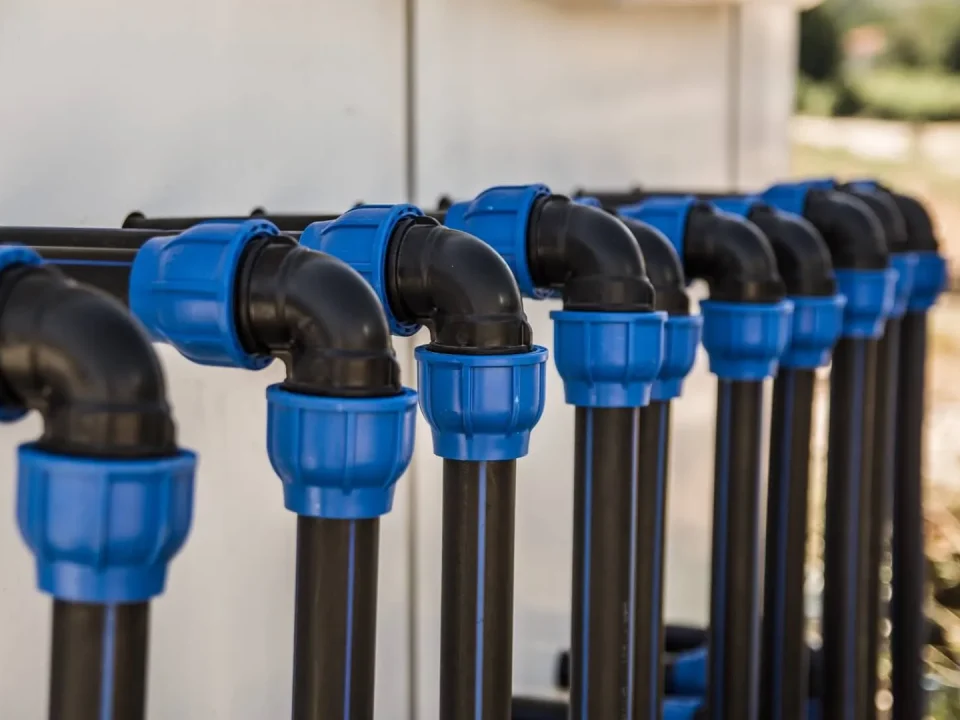
This is where an Irritec project becomes a true system: dripline, pipes, fittings, valves, filters, controllers and sensors are not separate elements, but parts of a network designed to ensure uniformity, accessibility, maintenance and resource savings.
Irritec for designers, installers and retailers
Professional landscaping requires systems that are easier to understand, better integrated and simpler to manage: sprinkler irrigation where surface coverage is needed, micro-irrigation where precision is required, dripline for linear or mulched planting areas, the Armonia® line where Camo® dripline, pipe and fittings must blend into the surrounding environment, subsurface irrigation where the project requires invisible systems, and controllers and sensors where differentiated management is essential.
With Irritec, it is possible to build a complete landscape irrigation proposal: driplines suitable for subsurface irrigation, the innovative Armonia® system and a full range of dedicated drippers, pipes, fittings, valves, filters, controllers and sensors. For designers and installers, the choice is not between “sprinkler or drip”, but between solutions to be combined according to layout, pressure, flow rate, soil, maintenance needs, aesthetics and level of automation.
You can find the Irritec residential irrigation catalog here.
To receive support from our technicians in choosing the right products and designing the system, click here.