

Table of Contents
Water sources in agriculture: the role of surface water
The water used in agriculture comes from different sources: groundwater, as well as rivers, lakes, basins, reservoirs and distribution networks. According to Food and Agriculture Organization data from FAO AQUASTAT, the distinction between groundwater and surface water is central to irrigation management worldwide. In Europe, official statistics show that the use of these sources varies significantly depending on the area, with collective irrigation systems and storage basins playing an important role.

According to the European Environment Agency, agriculture accounts for around 29% of annual water abstraction in the European Union, with much higher percentages in the Mediterranean area. The sources used include both groundwater and surface water — rivers, lakes, reservoirs and collective irrigation networks — which continue to play a key role in European agricultural systems. Between 2000 and 2023, the EEA reported a 13% decrease in agricultural abstraction from surface water and, at the same time, a 52% increase in groundwater use. This points to growing pressure on water resource management and to the increasing variability of surface water availability.
This variability should also be read alongside another, more general figure on water abstraction in Europe: around 75% of freshwater abstraction comes from surface water, while around 25% comes from groundwater.
For this reason, optimising the use of surface water today also depends on new public and private policies aimed not only at implementing smart irrigation, but also — gradually — at increasing the use of treated wastewater.
In any case, when surface water is used, availability is not the only issue. Quality is just as important. Sediments, silt, sand, organic residues and algae are typical of these sources and create specific challenges in drip irrigation systems, where passageways are narrow and sensitive to clogging.

Emitter clogging: a progressive and often invisible problem
In drip irrigation systems, an inaccurate assessment of water quality increases the risk of a gradual reduction in emitter flow rate. The main causes of clogging can be grouped into three categories:
- physical: sand, silt and other suspended solid particles
- biological: algae, bacteria and biofilm formation
- chemical: precipitation of salts, such as carbonates and iron
The most critical aspect is the progressive nature of the problem. Even while the system continues to operate, it may gradually lose distribution uniformity. This increases the risk of uneven irrigation, which can be difficult to detect and may have a direct impact on crop development and productivity.
Multi-stage filtration: the correct technical configuration
To use water from reservoirs or canals efficiently, the system must be designed with several filtration stages, sized according to the quality of the water source.
Recommended configuration
Irritec filtration solutions
In a complete system, Irritec technologies make it possible to build this architecture efficiently:
- Hydrocyclones for the initial separation of solids with higher specific weight
- automatic sand filters to manage organic matter
- screen or disc filters, available in manual or automatic versions, to provide final protection and ensure operational continuity

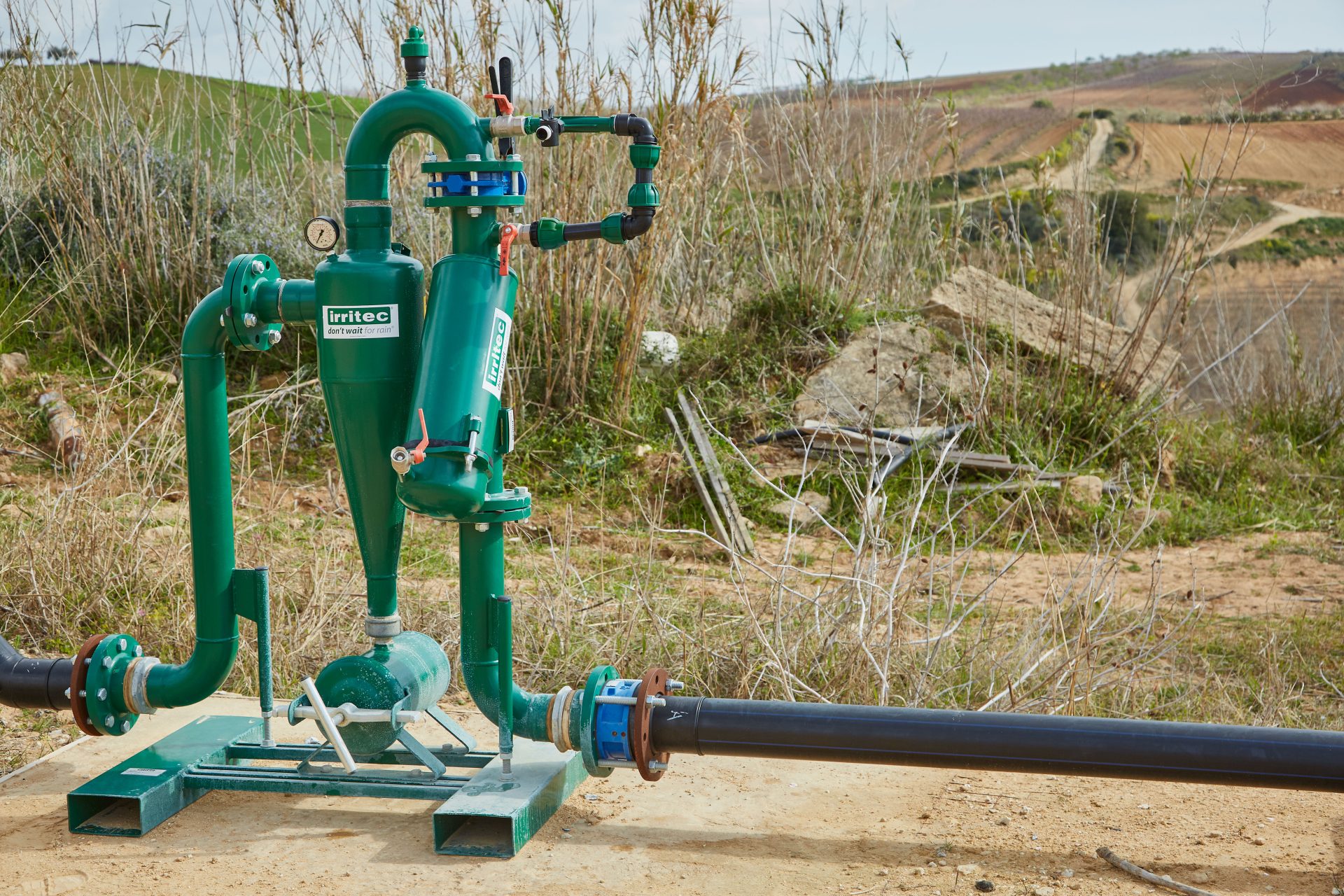

The integration of these elements helps maintain stable performance even when water quality varies over time.
Irrigation system design: key technical criteria
Filtration is the heart of the system, but it must be supported by consistent design choices along the entire line.
Sizing and management
A properly designed system must take into account:
- flow rate and quality of the water source
- head loss introduced by the filters
- frequency and automation of backwashing
- maintenance requirements and system accessibility
A common mistake is to undersizing the filtration system compared with real operating conditions, especially when water quality varies seasonally.
Choosing the right driplines
When using surface water, it is essential to choose driplines designed for challenging conditions, with:
- internal filtration systems in the emitter
- anti-clogging geometries
- high distribution uniformity
This helps increase the overall resilience of the irrigation system, reducing the risk of clogging over time.
From water quality to irrigation quality
Using water from reservoirs or canals is a strategic solution for agriculture, but it requires a more advanced technical approach than more traditional water sources. The goal is not simply to distribute water, but to manage a complex and variable resource.
With the correct filtration design, integrated solutions and an appropriate choice of components, it is possible to ensure uniformity, efficiency and long system life. In this way, surface water can also be used reliably in drip irrigation systems, while maintaining high agronomic performance over time.


