

Table of Contents
The importance of filtration in drip irrigation
In a drip irrigation system, water flows through emitters with extremely small passageways designed to deliver each drop with precision. This is what makes the system so efficient—but to keep it performing at its best, it must be protected against sand, silt, clay and any type of suspended micro-particles.
For this reason, the filtration unit is effectively the heart of the system. Without proper filtration, the irrigation network can accumulate:
- sand, silt and clay
- organic residues, algae and biofilm
- abrasive particles that damage components
The consequences are well known: recurring clogging, reduced emission uniformity, unexpected pressure drops, increased maintenance, and a shorter lifespan for driplines, pipes and valves.
When filtration is correctly sized and configured, the irrigation system operates “in the background”: clean water reaches the emitters, fertigation runs safely, and farmers are not forced to intervene constantly to clean or replace components.

Choosing the right filtration based on water quality
Selecting a filtration system always starts with one essential question: What type of water is being used?
- Well water often contains sand and coarse mineral particles.
- Surface water—from canals, rivers, lakes or reservoirs—may contain silt, clay, algae, plant debris and organic matter, with turbidity levels that fluctuate throughout the season.
- Reclaimed or treated wastewater typically presents a higher organic load.
To design the filtration system properly, it is essential to:
- analyze water during periods of highest turbidity (e.g., late summer or after heavy rainfall)
- assess Total Suspended Solids (TSS) levels
- evaluate the type and quantity of organic material present
This information guides the choice of filtration technologies, which often work in combination.
Screen filters
Screen filters use a metal or synthetic mesh element. Filtration is superficial: particles are trapped on the surface of the mesh while clean water passes through.
They are ideal when water is relatively clean or when well water contains only moderate levels of coarse particles. In many irrigation systems, screen filters are also used as secondary “safety filters,” installed downstream of the main filtration station to catch any debris released from upstream failures or anomalies.

Disc Filters
Disc filters are designed to handle more challenging water conditions. The filter element consists of a stack of grooved discs that, when compressed, create a deep, three-dimensional filtering structure. Water is forced through a complex network of micro-channels, trapping particles throughout the depth of the element.
Their advantages include:
- large filtering surface area
- high retention capacity for fine inorganic and organic particles
- excellent compatibility with drip irrigation and fertigation
For medium and large irrigation systems, or when water quality is variable, disc filters often become the preferred solution.

Sand (media) filters
Sand—or media—filters are the most effective option when working with highly turbid surface water. As water flows through the sand bed, its velocity decreases and particles are captured throughout the entire depth of the media.
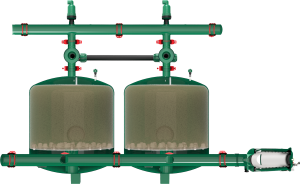
They are particularly suitable for:
- rivers, canals, ponds and reservoirs containing silt, clay and organic matter
- high flow rates and heavy suspended solid loads
- reducing particle load before disc or screen filtration
Hydrocyclones
A hydrocyclone is a sand separator that uses centrifugal force. Water enters tangentially into the hydrocyclone body; heavier particles are pushed outward and drop into a collection chamber, while cleaner water exits upward.
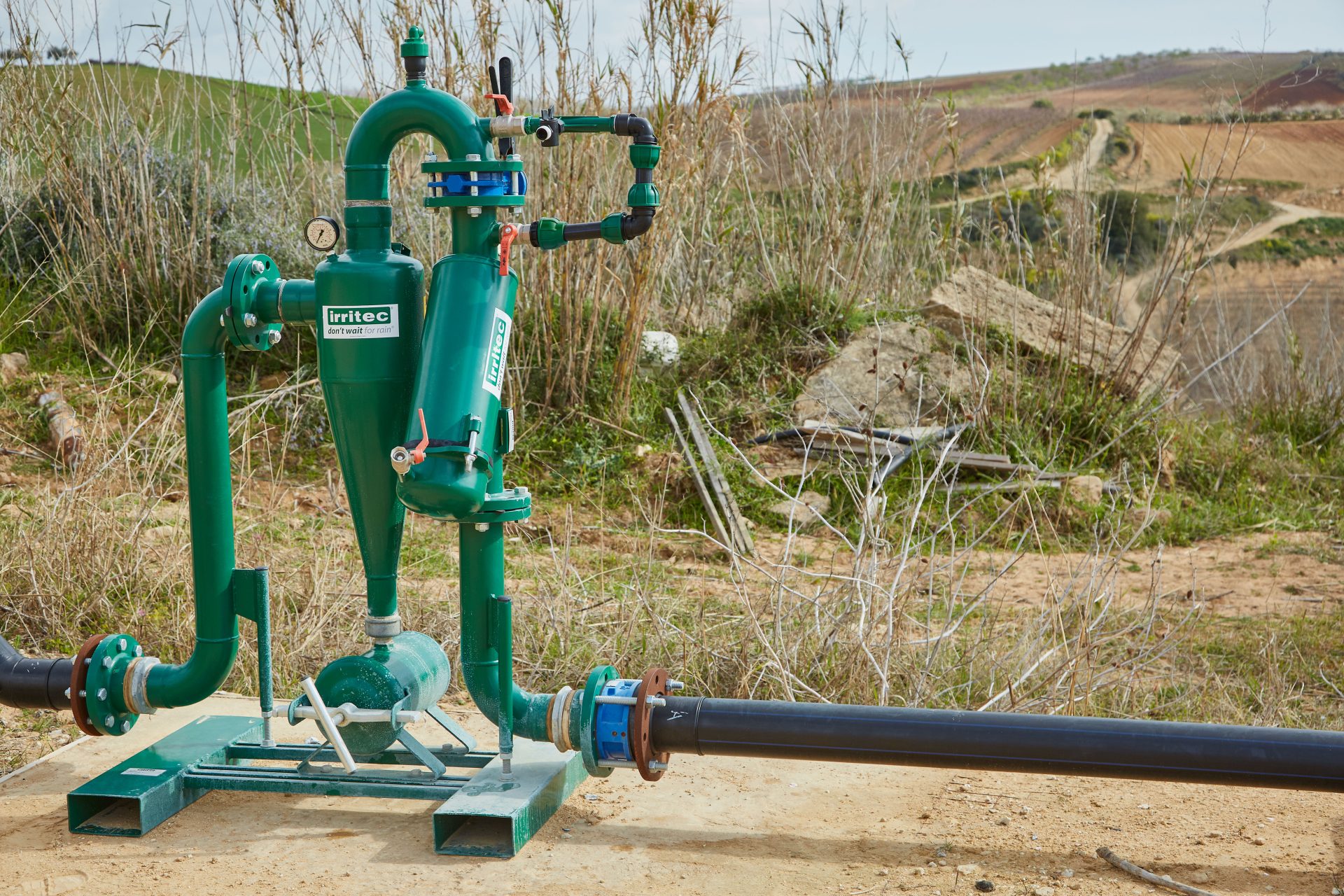
This is the ideal solution when the primary issue is sand — such as in many well water applications. Hydrocyclones are installed upstream of the main filtration station to protect downstream filters from abrasion and reduce the frequency of backwashing.
Irritec solutions for agricultural irrigation filtration
To cover the full spectrum of irrigation needs and water sources, Irritec offers a comprehensive range of filtration solutions. In the filtration section of our catalogue, you will find:
- Inline manual plastic filters (i-Filters™)
- Manual plastic Rotofilters™
- Automatic disc filters: Rotodisk® Automatic
- Plastic and metal hydrocyclones
- Manual metal screen and disc filters
- Metal sand filters
- Pre-filters, automation kits and additional accessories
All products feature durable, flexible filtering elements capable of withstanding pressure fluctuations and mechanical stress. Hydraulic sealing is ensured even at high pressures, and the wide range of filtration grades makes it possible to match the needs of any emitter or dripline.
Another key aspect is simplicity: every filter is designed to minimize maintenance and make inspection, cleaning and part replacement easier and faster.
To manage filtration batteries efficiently, automation is essential. The Commander FLT® controller simplifies daily monitoring and automatically manages flushing and backwashing cycles—ensuring optimal performance of the entire irrigation system.
Focus: Rotodisk® Automatic disc filters

Within the Irritec range, Rotodisk® Automatic filters represent an advanced solution for users seeking reliability and automation.
The housing is made of glass-fiber reinforced polyamide, while the filtering element consists of grooved discs. Thanks to the “Rotodisk” device, these discs generate a centrifugal effect during operation, keeping particles away from the filtering surface and delaying clogging.
Backwashing is automatic: a hydraulic-mechanical system reverses the flow, decompresses the discs, separates them slightly and cleans them with water jets that create rotation. This allows the filter to regenerate the media without interrupting irrigation and with optimized water use.
Introducing the new RSL 3″ LP system
Within the Rotodisk® Automatic family, the RSL 3″ LP is the latest evolution in efficiency and versatility. It is a modular inline filtration unit consisting of multiple 3″ Rotodisk® Automatic LP filters installed in parallel (“multi-head”), complete with manifolds, three-way valves, support legs and provisions for automation kits.
The LP (Low Pressure) designation highlights a key feature: the redesigned filtering stack enables effective backwashing at significantly lower pressures than traditional systems—requiring only 1.5 bar minimum. At the same time, the increased filtering surface further improves performance with difficult water, capturing more particles before backwashing is needed.
Main advantages of the RSL 3″ LP:
- larger filtering surface (1,675 cm² per element), increasing the interval between backwash cycles
- low backwash pressure requirement (1.5 bar), reducing energy consumption and pump sizing
- excellent performance with challenging water thanks to the combination of disc filtration and internal centrifugal effect
- modularity and compatibility with the Rotodisk® Automatic range, simplifying upgrades and system extensions
In practice, the RSL 3″ multi-head LP is designed for small, medium and large professional installations requiring substantial flow rates, continuous operation and reliable management of medium- to low-quality water.
When to choose RSL 3″ LP: a field example
Consider a real scenario: a 25–30-hectare fruit farm using drip irrigation, fertigation and water from an on-farm reservoir.
Water quality in this context varies significantly:
- after rainfall, silt and clay levels rise
- in hot months, algae and organic matter proliferate
- fine sand may appear due to sediment movement
If filtration is not aligned with these fluctuations, issues arise immediately: emitter clogging, frequent manual cleaning, pressure drops and uneven water and nutrient distribution.
A typical configuration may include:
- a primary filtration station with an RSL 3″ LP system sized to the system flow rate, equipped with 130 µm (microns) discs to protect emitters
- additional safety filters downstream of sector valves to further protect distribution lines
With this setup, water reaches the system consistently clean.
Low backwash pressure allows the pumping unit to operate efficiently without oversizing; automated backwashing minimizes manual intervention; emitter lifespan increases; and fertigation becomes more stable and repeatable over time.
For a farm working with high-value crops, this means turning a potential weak point—water quality—into a structural advantage for the entire irrigation system.
Filtration: a strategic design choice in agricultural irrigation
Filtration in drip irrigation is not a technical detail—it is a strategic decision.
Designing filtration correctly means protecting the irrigation system, ensuring uniform water and nutrient distribution, reducing maintenance costs, extending emitter lifespan and, ultimately, supporting the profitability of the farm.
In simple contexts, screen filters and manual solutions may be sufficient.
But when dealing with difficult water, large areas or high-value crops, systems like the RSL 3″ LP, integrated into a complete filtration strategy with hydrocyclones, sand media filters and safety filters, become essential tools for achieving long-term precision irrigation.
For support in designing or selecting the best filtration system for your crops, Irritec’s experts are always available to assist growers, installers and professionals.
Click here to get in touch with our team.


